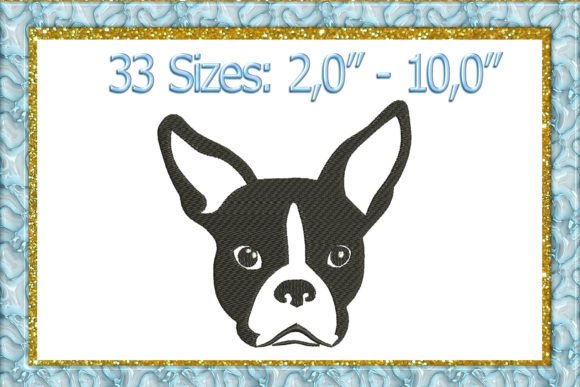
Boston Terrier Head: A Craft Fair Best-Seller Review
As an embroidery designer who has spent countless weekends behind a booth table, I know that not every digital file translates into a physical best-seller. We download hundreds of files, but only a select few earn their place on our sample racks. Today, I am reviewing the Boston Terrier Head machine embroidery design to determine if it deserves a spot in your next craft fair lineup. This review focuses on practical application, visual impact, and production viability for handmade product creators.
First Impressions: Whimsy Meets Charm
The moment you load the Boston Terrier Head into your software, the mood is immediately clear. The description promises whimsy and charm, and the visual output delivers exactly that. This is not a hyper-realistic portrait meant for serious pet memorials; rather, it is a stylized, approachable depiction that appeals to dog lovers looking for joy. For a craft fair environment, this distinction is vital. Shoppers browsing handmade markets are often looking for items that spark an immediate emotional connection or a smile. This design fits squarely into the "cute" and "whimsical" categories, making it highly effective for impulse buys.
When considering the Dogs category within Embroidery, Boston Terriers have a dedicated following. Their distinctive tuxedo markings and expressive eyes make them recognizable even in simplified stitch forms. This recognizability is crucial for a craft fair product because customers need to understand what they are looking at from three feet away. If the design were too abstract, it might fail to catch the eye of a passerby. However, this design strikes a balance between detail and simplicity, ensuring it reads well from a distance.
Product Applications and Market Fit
To maximize sales, you must pair the right design with the right substrate. Based on my experience with similar embroidery file assets, here is how the Boston Terrier Head performs across various small shop product lines:
- Tote Bag Design: This is arguably the strongest application. A medium-sized hoop placement on a canvas tote allows the design to be the focal point. It appeals to dog owners who want to carry their love for their pets visibly. Ensure you use a heavy cut-away stabilizer to prevent puckering on the loose weave of canvas.
- Tea Towel Embroidery: Kitchen textiles are perennial favorites at markets. Stitching this design on the corner of a flour sack towel creates an affordable gift item. However, be mindful of fabric texture. Terry cloth can swallow small details, so this design works best on smooth waffle weave or plain cotton towels where the stitches can sit cleanly on the surface.
- Apron Embroidery: Positioning the head on the bib of a half-apron creates a charming look for home cooks. It adds personality without overwhelming the garment. This is a excellent way to increase the perceived value of a basic apron, turning it into a unique handmade product.
- Embroidered Patch: If your machine supports smaller hoops, this design makes a fantastic iron-on or sew-on patch. Patches are low-cost to produce and high-margin. They allow customers to customize their own jackets or bags, increasing engagement with your brand.
- Pillow Covers: For home decor buyers, a centered design on a linen or cotton pillow cover adds a touch of whimsy to living spaces. Ensure the thread colors contrast sharply with the fabric to maintain the crispness of the Boston Terrier’s features.
Production Practicalities for Etsy Sellers and Boutique Makers
For Etsy seller accounts and boutique makers, batch production efficiency is key. The Boston Terrier Head appears to be designed with reasonable stitch density, avoiding excessive layering that could cause thread breaks or fabric distortion. However, before committing to a large run, you must conduct thorough testing. Every machine behaves differently, and every digital embroidery file interacts uniquely with your specific thread brands.
One critical consideration is the size scalability. While the design is lovely, shrinking it too much for small items like coin purses may cause the facial features to merge. Always check the minimum recommended size in your software. Conversely, blowing it up too large for a blanket might reveal gaps in the stitch pattern if the original digitizing was optimized for a smaller hoop. Stick to the intended scale for the best finished product quality.
Photography is another major factor. This design photographs well because of its clear outlines and contrasting colors. When creating your printable mockup or listing images, ensure the lighting highlights the texture of the stitches. Flat lighting can make embroidery look like a print, which devalues the commercial embroidery effort. Show the dimensionality of the thread to justify the price point.
Careful-Use Notes and Technical Adjustments
While this design is versatile, there are technical pitfalls to avoid. First, consider the background fabric color. Boston Terriers are typically black and white. If you stitch this on a dark navy or black fabric, the black portions of the dog will disappear. You must either use a lighter fabric or adjust the thread colors in your software to create contrast, perhaps using a dark gray instead of black for the outline. On white fabric, ensure your bobbin thread matches the top thread or the backing fabric to avoid visible dots through the design.
Curved surfaces, such as caps, present another challenge. The Boston Terrier Head has a rounded shape that can work on a cap front, but you must use a strong stabilizer and possibly a topping if the cap material is textured. Without proper stabilization, the design may pucker, ruining the aesthetic. Always test on a scrap piece of the exact material you intend to sell.
Additionally, review the hoop size requirements. The product description mentions it comes with multiple formats, but it does not specify exact dimensions. You must open the file in your embroidery software to confirm it fits your available hoops. Do not assume compatibility. If the design is larger than your standard 4x4 hoop, you may need to resize it or use a larger machine, which affects your production workflow.
Enhancing Brand Consistency and Buyer Engagement
Incorporating the Boston Terrier Head into your product line can strengthen your brand if you position it correctly. It signals that your shop offers fun, high-quality, and personalized items. For design assets and marketing, use this design to create cohesive social media content. Show the design on a variety of products to demonstrate versatility. This helps buyers visualize the item in their own lives, increasing buyer engagement.
Finally, always verify the licensing terms. The description states it is for embellishing fabrics, but you must confirm if it includes commercial embroidery rights for selling finished physical goods. Most designers allow this, but some restrict it to personal use only. Protect your business by reading the license file included with the download. If it is not explicitly stated, contact the designer before selling any finished product.
In conclusion, the Boston Terrier Head is a strong contender for your next market season. It offers broad appeal, works well on high-volume items like towels and totes, and brings a necessary touch of whimsy to your display. With careful attention to fabric choice, stabilizer selection, and color contrast, this design can become a reliable revenue generator for your handmade business.